If you are a foreign national in Thailand, you can get an HIV test here, and at least one anonymous clinic in Bangkok publishes a single price list with no nationality condition on it. What differs is who pays, because the health coverage Thai citizens hold is not coverage you can use in their place. This guide covers where to start, what to ask before you go, and what the published pages do not say.
If you read only one line: "where can I get tested" and "who pays for it" are two separate questions. If a possible exposure happened within the last 72 hours, get to a service first and sort out money and paperwork at the counter.
Where can a foreign national get an HIV test in Thailand?
The easiest place to start is a service that publishes its own services and prices. The example we read through is the Anonymous Clinic at the Thai Red Cross AIDS and Infectious Diseases Research Centre on Ratchadamri Road in Bangkok.
Its clinic services page lists, in one place: testing for HIV infection, emergency medicine after a possible exposure, preventive medicine taken before possible exposure, testing and treatment for sexually transmitted infections, and HIV self-test kits for sale.
What this means for you: choose a service that publishes its list, hours and prices, then call the number on that page. For a structured way to compare options, read HIV Clinic Near Me: How to Find Trusted HIV Support Services in 2026. If you are unsure which test to ask for and when, read HIV Testing FAQ: Types, Timing and Results first.
What documents should you bring?
This part has to be said plainly. None of the centre's pages we read — clinic services, service rates, opening hours, online registration — states which identity documents you need, and we are not going to guess that for you.
What the pages do say is that new and returning clients can register online before coming in. You then receive a six-digit code to confirm your identity with staff, and that code is valid for 72 hours only. So call ahead with this list of questions.
- Do I need a passport or another identity document, and can I still be seen if I do not have one with me?
- Can you issue a medical certificate in English, and what is the fee?
- In what form will I receive my result, and who else is allowed to see it?
What about language at the counter?
No page we found states which languages a service's staff speak, or whether interpreters are available. So do not assume every service point can work in English. Call ahead about the hours you plan to come, and write your questions down as a list. Bring a Thai-speaking friend if you have one.
What does it cost, and why Thai coverage is not your coverage
The Thai Red Cross AIDS and Infectious Diseases Research Centre publishes the Anonymous Clinic rates on its website. The figures below are in-hours rates at that one clinic, not a national standard price. The page itself notes that rates may change.
| Service | In-hours rate | Result time |
|---|---|---|
| Blood test for HIV infection | 160 baht | 1 hour |
| HIV testing by NAAT (detects the virus's genetic material) | 1,000 baht | 1 working day |
| Screening panel for four sexually transmitted infections | 1,200 baht | 3 working days |
| Finger-prick HIV self-test kit | 300–400 baht | – |
If a possible exposure was recent, ask the service which test suits your timing. The same page also adds fees on top of the rates above:
- in-hours visits: a 50 baht basic service fee
- the after-hours clinic: a 400 baht doctor's fee and a 150 baht service fee
- after-hours laboratory tests: 20% above the in-hours price
- after-hours antiretroviral medicine: 10% above the in-hours price
All of that is a published price, which is a different thing from coverage. A study published in a peer-reviewed journal in 2019 sets out the difference. Thailand's Universal Coverage Scheme for Thai citizens had covered antiretroviral treatment (ART) since 2006. The Health Insurance Card Scheme is a separate card run by the Ministry of Public Health, which people who are not Thai citizens buy for themselves. Antiretroviral treatment was only added to its benefit package in 2013.
The scope of that study matters just as much. The authors write that their fieldwork was confined to undocumented migrants from Cambodia, Laos and Myanmar and their dependants. Tourists, expatriates and refugees in temporary shelters were outside it.
The same paper does discuss expatriates, though not from that fieldwork. It reports that the 2013 regulation for the insurance card did not specify the buyer's nationality, and that a minister announced its beneficiaries would include all non-Thais not already covered by social health insurance. It reports the other half too. In July 2014 the ministry asked facilities to stop selling the card to western foreigners and await further announcements. By the time that 2019 paper was written, no further official message had followed. So this is not a card to plan around. Ask the service and your own insurer instead.
What this means for you: treat any claim that "testing is free in Thailand" with care, because that sentence comes from the entitlements of Thai citizens. Assume each service sets its own rates, and ask for the total up front.

What does travel or health insurance cover?
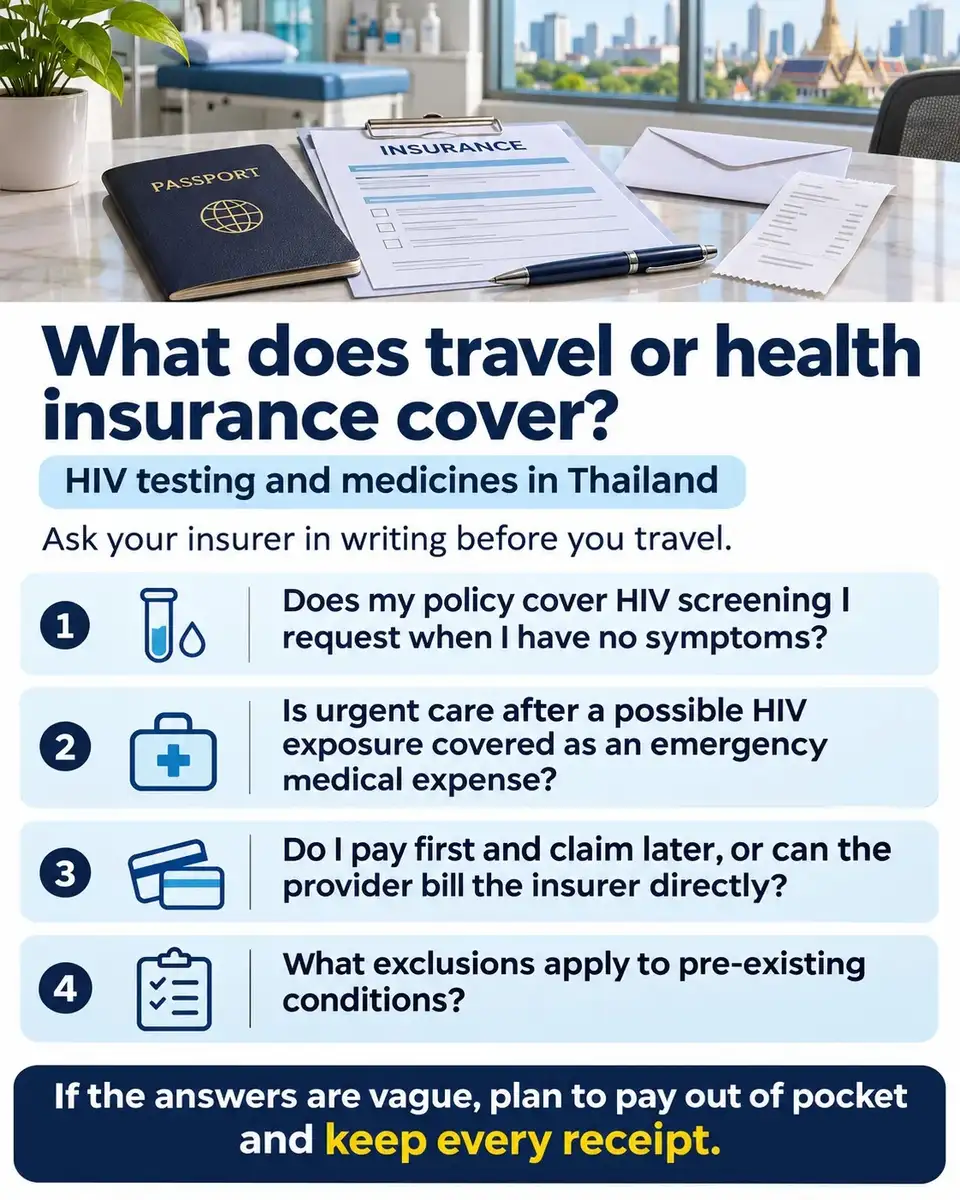
No page from any authority told us which travel or health insurance products cover HIV testing or medicine costs in Thailand, so there are no figures or product names here. Ask your insurer in writing before you travel.
- Does the policy cover screening you request yourself when you have no symptoms?
- Is urgent care after a possible exposure treated as emergency medical expense?
- Do you pay first and claim later, or can the provider bill the insurer directly?
- How are pre-existing conditions excluded?
If the answers are vague, plan to pay out of pocket and keep every receipt.
If a possible exposure happened in Thailand
The centre's PrEP and PEP service page describes PEP as emergency antiretroviral medicine, given to clients exposed to HIV no more than 72 hours earlier. Clients can come in for counselling and a risk assessment. The page also states that if the blood test that day finds no infection, the client is given medicine to protect themselves.
WHO's guidelines document on HIV post-exposure prophylaxis states that timely access is the most crucial factor. PEP is most effective when started as soon as possible, ideally within 24 hours and no later than 72 hours after exposure, that document says. It also recommends a 28-day prescription. Who is suitable for what is assessed person by person.
Opening hours matter here. The centre's opening-hours page shows the in-hours clinic running Monday to Friday, and the after-hours clinic on some weekday evenings and Saturday morning. Every slot has a queue-closing time, and the clinic closes on Sundays and public holidays. One caution: that page and the PrEP and PEP page on the same site do not give identical after-hours times, so call to confirm.
What this means for you: if something happens on a Saturday night or during a long holiday, the 72-hour clock does not pause for a clinic's closing days. Do not wait for this one clinic to open. The timing in WHO's document is counted from the exposure, not from opening hours. So start trying to reach a service that is open to you on the same day, and ask whoever answers where PEP can be started now. If you are past 72 hours and thinking about longer-term prevention instead, read HIV Prevention and PrEP: Options for Different Exposures.
If you already take HIV treatment and are coming to Thailand
The verifiable point is this: the centre's service list says it dispenses HIV antiretroviral medicine "according to a doctor's prescription". In the rate table, the antiretroviral line is priced per prescription rather than at a fixed figure.
What this means for you: bring a prescription or a letter from the clinic that looks after you. Whether a prescription issued abroad is accepted is not written on those pages, so call and ask. The rate page also lists the viral load test, which shows how well treatment is holding the virus down, at 1,250 baht.
If you learn you are HIV positive while you are in Thailand, look at the centre's Same-Day ART service page. It describes starting antiretroviral treatment on the same day the infection is found, or within 72 hours of learning the result. It lists this as an in-hours service from Monday to Friday. For a plain-language picture of what staying on treatment means day to day, and what U=U means, read HIV Treatment and Quality of Life: A Practical Guide.
Frequently asked questions
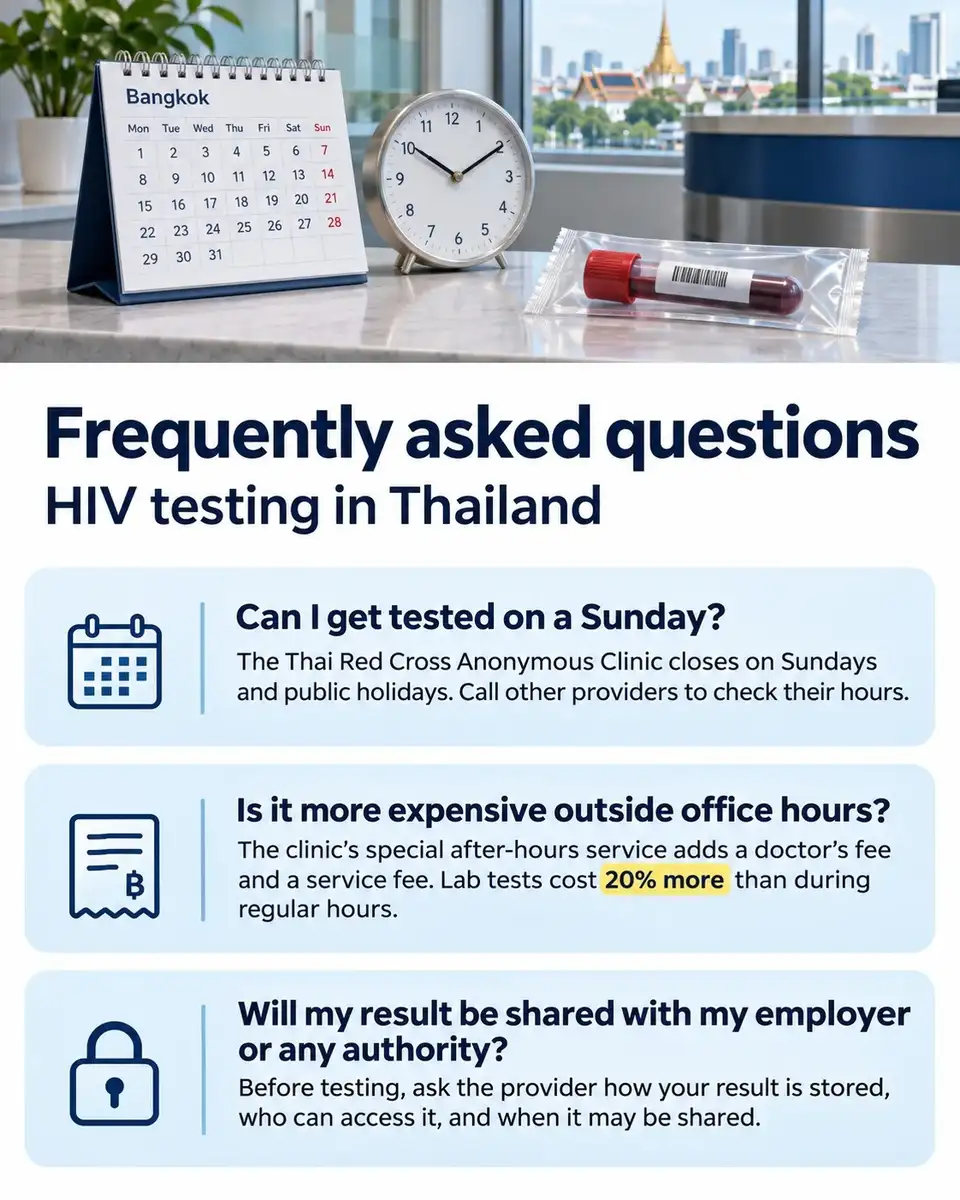
Can I get tested on a Sunday?
The centre's opening-hours page states that it closes on Sundays and public holidays. Other services set their own schedules, so you have to call each one.
Is it more expensive outside office hours?
Yes. The rate page states that the special after-hours clinic adds a doctor's fee and a service fee, and charges laboratory tests 20% above the in-hours price.
Will my result be shared with my employer or any authority?
Nothing we read from any service sets this out clearly, so we are not going to answer for them. Ask the service directly before testing how results are stored and who can access them.
In short
Finding a place to test is the easy part. Coverage is a separate question, and the entitlements Thai citizens hold are not yours. Documents and insurance are the two points with no source behind them, so get answers to those before you arrive. And if an exposure has just happened, time matters more than paperwork.
Getting tested, or going along with someone who is testing, is nothing to feel awkward about. It is ordinary self-care. If you are unsure about your own situation, call a service near you and ask.
Note This article is general information. It is not a diagnosis and not personalised advice about medicines. Decisions about medicines and treatment are made with the doctor or pharmacist who looks after you, and you should not buy, start, stop or adjust medicine on your own. If you have questions about your own health, you can always talk to a health worker or a clinic near you.
Sources
- Service rates — Thai Red Cross AIDSID
- PrEP & PEP services — Thai Red Cross AIDSID
- Opening hours — Thai Red Cross AIDSID
- Guidelines for HIV post-exposure prophylaxis — WHO
- The Devil Is in the Detail — Understanding Divergence between Intention and Implementation of Health Policy for Undocumented Migrants in Thailand (IJERPH, 2019)